Tech Enabled Environmental Research
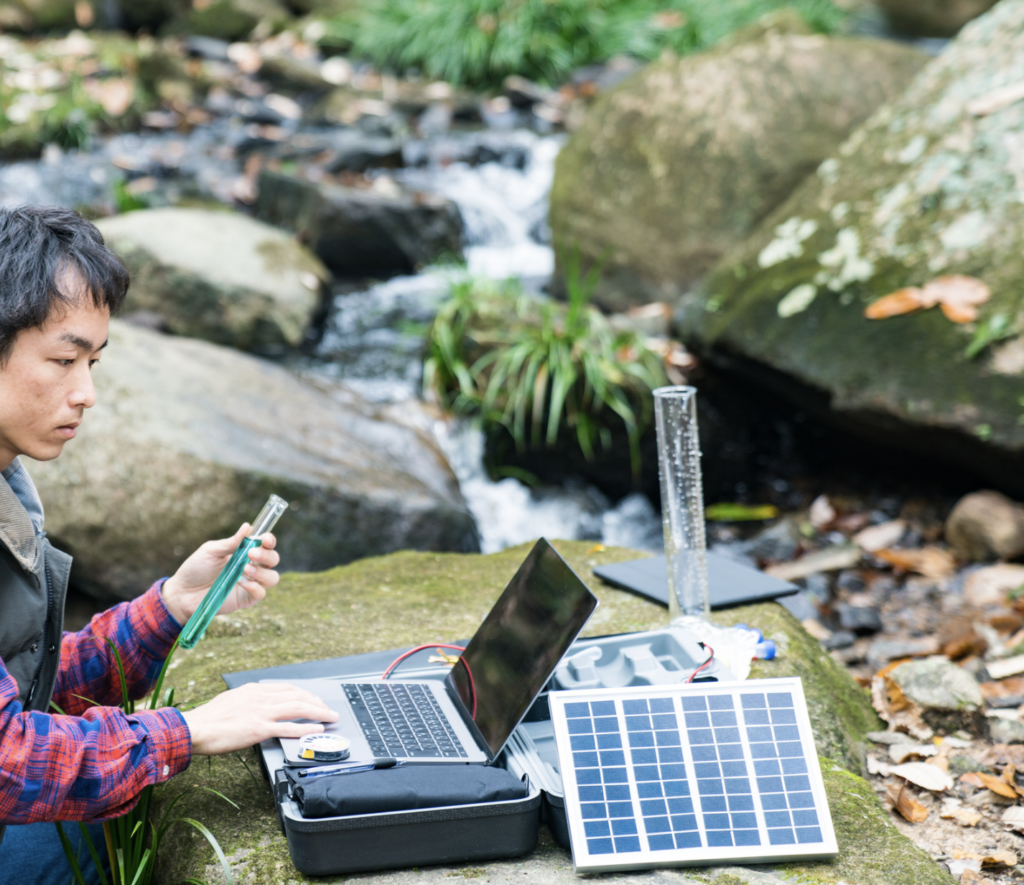
Photo by tdub303 via Canva Prof
By Anasa Laude
(Part of this was posted on Substack and I’ve expanded it here).
Tech Build Africa recently reported on the rise of AI-powered agriculture. In Northern Uganda, a colleague of mine, a recent grad student, launched a social enterprise to support young farmers in her village who were dealing with “tough” land due to frequent droughts delaying planting, followed by extreme flooding threatening to wash out the seedlings they managed to grow. All in one season.
These farmers are now exploring AI tools to support training and farming data to help with management. They also want to learn to speak English, and access to AI may help accelerate that. Another close colleague of mine, an economics professor, and his students are using AI to collaborate with farmers in Brazil, learning about finance and cost-benefit analysis. AI-powered drones gather soil data on the Brazilian farm, and then the team helps evaluate the AI output. They use LLMs to help with translation.
I have been observing the debate around AI, and outside of the US it’s not as cut and dry. And based on what I’ve learned so far, in some parts of the world, learning how to use AI and apply it is not viewed as optional. In addition to agricultural uses in Africa, there are countless stories of AI models used to facilitate early warning systems for flooding, aiding in evacuation—a community-owned AI tool in the Amazon, for instance. And as I recently learned from authors here on Substack, AI tools are being used in Venezuela to help locate survivors.
Shaming a farmer in Uganda or a rescue worker in Venezuela for using an LLM to survive is intellectual laziness. But accepting that Silicon Valley corporate monopolies must permanently own the infrastructure of that survival is a failure of imagination. If we are going to look at this from all sides, we must actively ask: what does an alternative look like? How do we build a world of local and sovereign AI?
I am still learning about all of this so what I am sharing is based on my understanding thus far:
True “Sovereign AI” rejects the massive cloud architecture of Silicon Valley. It replaces it with what researchers call “Small AI” or localized “Edge AI”—small, fine-tuned, privacy-preserving models deployed directly on local devices or community-owned servers. We can look to movements like the Global Indigenous Data Sovereignty Network, which advocates for OCAP principles (Ownership, Control, Access, and Possession). They treat data like physical land, ensuring communities choose who benefits from their data and who has the right to say “no”.
In practice, this looks like projects such as the First Nation Languages AI initiative, which builds offline, edge-AI speech recognition devices so language data never leaves the community or hits a corporate cloud plane. Instead of building massive, multi-billion-dollar foundation models from scratch, ecosystems like IndiaAI focus on an “applications-first” model—taking existing open-source architectures and fine-tuning them on localized data to target specific regional problems without corporate licensing dependencies.
But we also have to confront the physical footprint of AI—massive data centers extracting local water and straining electrical grids—which is an emerging environmental justice crisis. Communities are proving they are not helpless against these corporate land grabs. Activists are slowing down and stopping data center expansions by organizing at the most local levels. In places like Virginia and Brazoria County, Texas, residents have packed zoning commission meetings and city council public comment periods, successfully blocking massive projects by challenging their tax abatements and utility strains. Frontline frameworks designed by groups like the NAACP advocate for strict municipal “Transparent Footprint” mandates, pushing for local laws that require real-time reporting of energy and water emissions. If a tech giant cannot prove its data center won’t dry out local aquifers or spike utility bills for residents, their permits are denied. Globally, coalitions like the Global Digital Justice Forum (GDJF) are pushing back at the regulatory level against the use of eminent domain, demanding that tech corporations be held financially and legally liable for the ecological destruction their infrastructure causes.
To support less wealthy nations in this fight, global digital activism must move away from top-down “tech charity” and toward a model of decentralized, South-South Solidarity. We need global idea exchanges that bypass Silicon Valley tech summits entirely. This means creating issue-specific working groups where a Data and Language Track can connect Latin American NLP initiatives (like LatAm-GPT) directly with India’s Bhashini project and African language-model developers to align open-source licensing. It means treating local solutions as a “Digital Commons” playbook—so when a team in Nigeria develops a localized AI system for crop management, they don’t patent it; they share the entire training framework, prompt library, and edge-compute architecture openly with cooperative networks in Indonesia or Brazil. Initiatives like the Global South Network for Trustworthy AI are already working to build these shared instruments for local safety, risk-sandboxing, and algorithmic accountability.
I work with schools to integrate sustainable building and embed career and technical education across the curriculum, and I facilitate discussions on the role of technology, including AI, in building performance assessment and design. These discussions are nuanced. Whether or not to use AI, in what form (LLM versus AI-powered software), and how to disclose its use all take real judgment.
The underlying principle I keep coming back to is that humans using AI must be knowledgeable enough to discern when AI is helpful or harmful. You need someone with years of experience and education to help guide AI, and as a student starting out, you’re not there yet, so always pull in a trusted advisor. We talk through concerns around energy and water, how scientists have been using AI for predictive modeling, and where students land on it themselves, which is all over the spectrum, from completely against it to using it to create practice questions for study. We go through scenarios of both misuse and usefulness.
My aim with this workshop and my teaching over the years has been to let students sit with nuance and find ways of extracting the net impact of a decision. I am against blind use. I agree with the points on data centers and ecological impacts. I am against governments using eminent domain to facilitate corporate land grabs to build them. I am against a handful of mega companies creating “moats” around a tool that has become important to many of us.
Corporate greed across all sectors has had deadly consequences globally for decades, and unchecked greed in the tech sector with AI will also have deadly consequences if left unchecked, especially for people who never get a say in how it’s built or where. All we can do in our respective roles is see it from all sides and navigate it with open minds and empathy. My worry about job loss as I write this from my NYC apartment is different from the worry of the Uganda farmer trying to make it another day. Who am I to shame anyone for the decisions they make on using technology?
- Where do you find yourself on the spectrum between immediate daily utility and long-term systemic worry?
- How can we, in our own communities and organizations, shift the conversation from passive corporate dependence to active data sovereignty?
If this piece resonated with your work, consider sharing it with an educator, activist, or entrepreneur navigating these same tensions.
About Author
Anasa Laude, LEED AP BD+C supports schools with project-based, community STEM learning with a focus on climate resilience and responsible, safe AI.